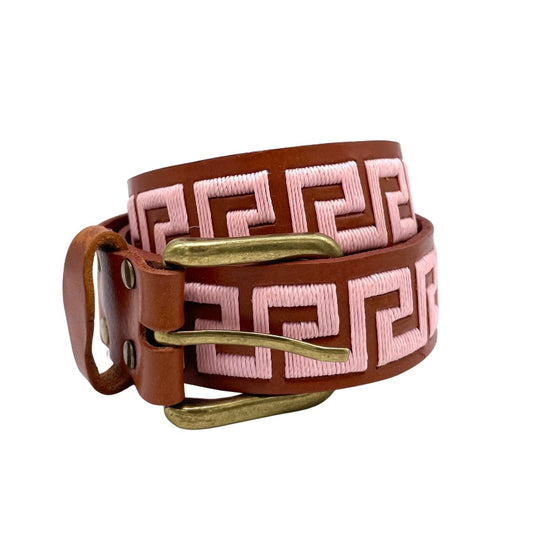
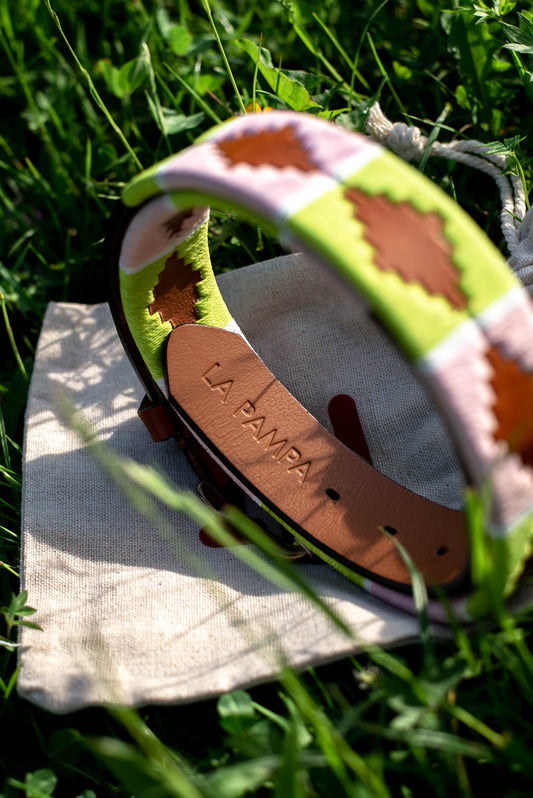
A polo belt is a thick leather belt with a pattern stitched through it by hand in coloured waxed thread. The style comes from Argentina, where you see it at every polo field and around the stables. Ours are cut from stirrup leather, 35 mm wide, and Leo and his team in Buenos Aires stitch each one by hand. A single belt takes them up to eight hours.
In English-speaking shops "polo belt" can also mean a woven fabric belt with leather tabs at the ends. That's a different thing. This article is about the Argentine kind: leather, a needle and a lot of thread.
What makes a belt a polo belt
Look closely at one and you'll see the pattern isn't printed or woven in. Holes are punched through the leather in rows, and the thread is pulled through them stitch by stitch until it covers the surface in blocks of colour. The leather shows through where the pattern leaves gaps, usually as diamonds or steps. The last stretch of the belt, where the holes for the buckle are, stays plain.
The thread is waxed nylon. The wax helps it slide through the leather and keeps the stitches tight, and nylon doesn't rot when it gets wet, which matters on a belt that ends up near horses.

Where the polo belt comes from
The honest answer: nobody wrote down who stitched the first one. What is documented is how deep polo goes in Argentina. The Asociación Argentina de Polo was founded on 14 September 1922, and before that the game was already organised under the Polo Association of the River Plate (Wikipedia). Leatherwork for horses has an even longer history there, and the embroidered belt grew up in that world of saddlers, grooms and players. Today it's worn around the stables as much as on the field.
The stepped diamond you see on many belts, and in the band that runs across this website, is known as the guarda pampa. The Argentine government's culture pages describe the guarda pampa poncho as the work of women weavers in La Pampa province, descendants of displaced Ranquel communities, who weave it in sheep's wool using an ikat technique (argentina.gob.ar). You'll also read online that the diamond is an Aztec motif. The Aztecs lived in central Mexico, several thousand kilometres north of the Pampa, and we couldn't find a source for that claim.
How our belts are made
We use stirrup leather, the same heavy, vegetable-tanned leather that stirrup straps on a saddle are made from. Those straps carry a rider's weight, so the leather is firm and dense. Our standard belts are 35 mm wide and 5 mm thick; a few slim designs are 30 mm wide and 3 mm thick.
Leo and his team in Buenos Aires do the stitching. Every pattern is worked thread by thread, and the dense designs take up to eight hours per belt. Because it's done by hand, no two belts are exactly the same. A stitch might sit a millimetre higher or a colour block end a little earlier than in the photo. That's how you can tell it was made by a person.
The names come from all over. Some are Latin dances (Salsa, Cumbia, Bachata, Mambo, Flamenco), some are places in Argentina (Mendoza and Chaco for belts, Jujuy, Palermo and Recoleta for the dog collars), and a few are sweets: Caramelo, Dulce, Frambuesa. You can see the belts in the belt collection.
What it's like to wear
New, a polo belt is stiff. Stirrup leather needs a few weeks of wearing before it bends easily around your waist, and the hole you use most will soften first. After that it moulds to you and the leather takes on a look of its own. If you want to speed it up, just wear it; there's nothing you need to rub into it. Our care guide covers what helps and what to keep away from the stitching.
They suit jeans and chinos best. The pattern is the loud part, so a plain shirt or knit lets it show. Women often wear them lower on the hips over a dress, which needs a longer size; the size guide has a table for that.
Questions about polo belts
Do you have to play polo to wear a polo belt?
No. Players wear them, and so do plenty of people who have never sat on a polo pony. The name comes from where the style is seen most in Argentina, not from a rule.
Are polo belts for men or women?
Both. The designs are the same; only the size usually differs, because women tend to wear the belt in a different place. Our sizes go from 70 to 105 cm.
How long does a polo belt last?
Many years with normal wear. The leather is made to hold a rider's weight in a stirrup, and the nylon thread doesn't rot. The colours fade very slightly over the years, mostly in strong sun.
Is there a dress code at polo matches?
Usually not for spectators. Cowdray Park in England says there is no specific dress code for daily polo, and we couldn't find one for the German tournaments we looked at, including the German Polo Masters on Sylt. Wear flat shoes: you'll be walking on grass.